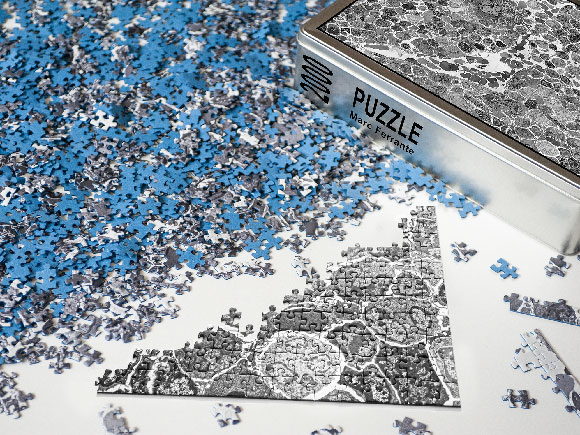
Patience passe science (Jigsaw puzzle microscopy). Vue au microscope électronique à transmission sur un échantillon de moelle osseuse, sous forme de puzzle de 2000 pièces 98 x 75 cm (21 ex). Tilling de 70 images, agrandissement x50.000 réalisé avec le soutien de l’INSERM et de l’EFS. © Marc Ferrante 2023-2025.
Microscopy is hard and tedious work. The technician or the scientist working at nanometer scale is a navigator washed up on the shore of an unknown country: over time, the microscope allows him to discover and later to understand, little by little, the correlations between the ingredients which are visible at molecular or cellular level and constitute a sample of life, captured by the net of the machine. The hope of gaining a better understanding and, perhaps, a mastery of life prompts one to figure out dizzy issues whose ins and outs remain unknown and invisible. This is the reason why electronic microscopy, like many other cutting-edge technologies, becomes the ideal ground for an “economy of promise”, based on a future already marked out by science-fiction and by the fantasies fueled by transhumanism.
Nevertheless, nanotechnology is not only a matter for scientists, industrialists and politicians: labs are not hermetic units, as the practical and ethical issues raised by their activity have implications for the society as a whole. Microscopy is also a cultural fact; it is a place where a collective experience occurs and where an imaginary world is sketched, a world foreign to the currently widespread deference towards technology, in which one can read the influence of utopias.
As I have been granted free access to an INSERM laboratory for several months, I started studying the archeology of these cutting-edge technologies, as I did with radiography. I devised several projects, one of them being this jigsaw puzzle. Everyone is invited to piece together this puzzle, which happens to be a very difficult one, due to its pattern and lack of colors. By trying to assemble what results from a microscopic view of sample of marrow, one will be able to reactivate in an original way the tedious experience of the scientist working at a nanometric level. Accordingly, one will also be able to toy with the interaction of each cell and protein participating in the picture through looking for the correct place of each piece of the jigsaw puzzle. All in all, will microscopy eventually change our relation to cells and bodies? And beyond the new insights we will get into them, will nanotechnology open really new horizons to us? Or do we have to celebrate the incompleteness of life, although we always try to overcome it?